Blog

  • What Is an IIP UN Certificate? A Complete Guide for Chemical Exporters

    What Is an IIP UN Certificate? A Complete Guide for Chemical Exporters

    IIP certification is a certificate that assures the quality of the packaging material in terms of passing the UN performance test for the carriage of dangerous goods. The Indian Institute of Packaging (IIP) provides this certificate for shipments by air as well as sea transport. The validity period is of 18 months for certified ISO 9001 factories and 9 months for others. This certification is increasingly becoming mandatory for carriers.

    Why Do Exporters Need an IIP UN Certificate?

    Exporters shipping dangerous goods from India need an IIP UN certificate for the packaging used to carry those goods. Without IIP certification, it could lead to rejection or detention of the booking at the last moment by shipping lines or air freight forwarders.

    This situation usually occurs right before the time of dispatch, as the shipping line requests the certificate and discovers that either it is not available, expired, or has been issued in the name of the packaging manufacturer and not the exporter.

    This document provides information about what the IIP UN certificate is, why it is needed by DGCA, DG Shipping, and the carriers, how long its validity period lasts, and how the exporter may acquire it.

    What Is an IIP UN Certificate?

    A UN certified package is one which is approved by the Indian Institute of Packaging (IIP), an autonomous institution under the Ministry of Commerce & Industry, for its performance against dangerous goods for the purposes of the United Nations (UN). The IIP is authorized by DG Shipping & DGCA to perform these tests.

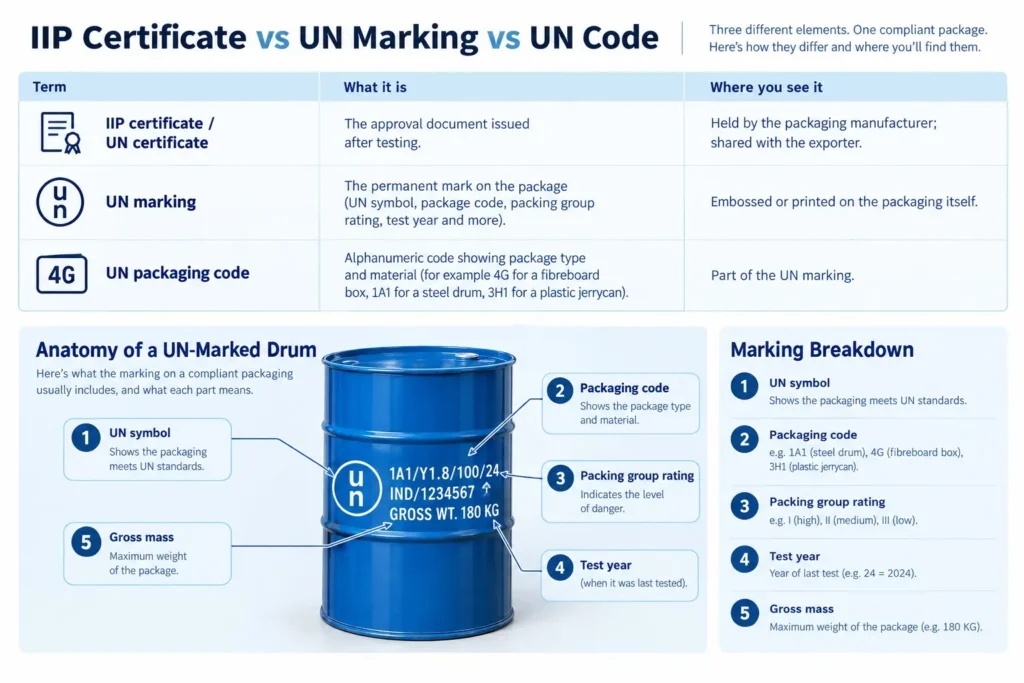
    It certifies the package and not the substance. It is applicable only to the designated packaging form like Drum, Jerrycan, IBC, Box/Composite Packaging and others.

    What Does the IIP UN Certificate Confirm?

    The IIP UN certificate confirms that a package has passed the required UN performance tests for transporting dangerous goods. These tests check whether the packaging can:

    • Withstand drops and handling impacts during transport.
    • Support stacking loads during storage and shipment.
    • Prevent leaks under internal pressure.
    • Compliance with UN marking specifications for its package and performance rating.

    Upon successful testing, IIP provides a digital UN certificate, test report, and UN markings specifications.
    Why Do DG Shipping, DGCA and Carriers Require a UN Packaging Certificate?

    Sea Cargo: DG Shipping and the IMDG Code

    Shipping of dangerous goods by sea is governed by the requirements for packaging under the International Maritime Dangerous Goods (IMDG) Code. In India, IIP is authorized to conduct testing of packaging and provide UN performance certificates for the shipping of sea cargo.

    Testing is carried out to ensure that packaging will stand up to the rigors of transport without leakage.

    Air Cargo: DGCA and IATA/ICAO Regulations

    Air consignment of dangerous goods should adhere to the relevant IATA Dangerous Goods Regulations, as per ICAO Technical Instructions. IIP is authorized to perform tests on packaging and issue UN certificates for air shipment in India.

    Certified packaging will help to avoid leaks and failures due to mishandling and other transit effects.

    Customs: Port Authorities and Shipping Lines

    The issuance of a UN packing certificate is not mandatory for all the shipments covered by the IMDG code. Nevertheless, the shipping line, forwarders, and other concerned parties may ask for it for checking the validity of the packaging.

    Failure to submit any document or having mismatched documentation will affect the process of acceptance of the shipment.

    How Long Is an IIP UN Certificate Valid?

    An IIP UN certificate is generally valid for 18 months for ISO 9001-certified packaging manufacturers and 9 months for non-ISO-certified manufacturers.

    Packaging manufacturerCertificate validity
    ISO 9001 certified18 months
    Non-ISO certified9 months

    What If the UN Packaging Certificate Has Expired?

    After expiration of the UN packaging certificate, it cannot be used for certification of any new packaging that has been manufactured. The packaging that has been manufactured prior to the expiration date of the certificate can still be used, as long as it satisfies all requirements.

    Certain carriers might not accept an expired certificate or one that is close to expiration at the time of booking.

    Common Validity Pitfalls

    • Certificate expiry: Some carriers reject certificates that expire before the cargo reaches its final destination.
    • Name mismatch: The certificate is issued to the packaging manufacturer. If the shipper’s name differs, the carrier may request clarification.
    • Wrong transport mode: A sea-only certificate is not valid for air shipments.
    • Chemical mismatch: The certificate covers the tested UN number, packing instruction and packing group. Different substances may require new testing.

    IIP UN Certificate for Hazardous Cargo: Which Shipments Need It?

    An IIP UN certificate may be required for export packaging used to transport dangerous goods, including:

    • Flammable materials: Solvents, paints, and adhesives
    • Corrosives: Acids, alkalis, and cleaning agents
    • Poisonous materials: Pesticides and chemical intermediates

    Oxidisers and organic Peroxides

    • Gases and aerosols: Where applicable packaging rules require UN certification
    • Other dangerous goods: Substances classified under UN dangerous goods regulations, depending on the packaging and transport requirements

    Some carriers may also request certification for limited quantity shipments. Confirm the applicable requirements with your freight forwarder and carrier before dispatch.

    UN Certificate Overseas: Is the Certificate Accepted Abroad?

    Yes. The IIP certificate confirms that packaging has passed the required UN performance tests. Its acceptance overseas depends on the applicable regulations and the requirements of carriers, consignees, and destination authorities.

    Before shipping, check three things:

    1. Destination requirements: Authorities may inspect the UN marking and request the test certificate.
    1. Certificate consignee requirements: The overseas consignees may ask for the copy of the certificate along with the shipment documentation.
    1. Accurate documentations: Lack of certificates or mismatch in markings may result in delays in the shipment due to additional storage and demurrage expenses.

    Maintain an updated digital version of the certificate along with the export documentation, and see to it that the packaging markings comply with the certificate documentation.
    Common Mistakes That Cause Delays in IIP Certification

    • Ordering packaging before confirming its certificate covers the chemical being shipped.
    • Assuming one certificate applies to every product using the same packaging.
    • Failing to verify whether the packaging is approved for air transport, sea transport or both.
    • Starting testing after the shipment has been booked.
    • Overlooking mismatches between the certificate and shipping documents.

    Management of IIP Testing and Certification by AL Falaah DG

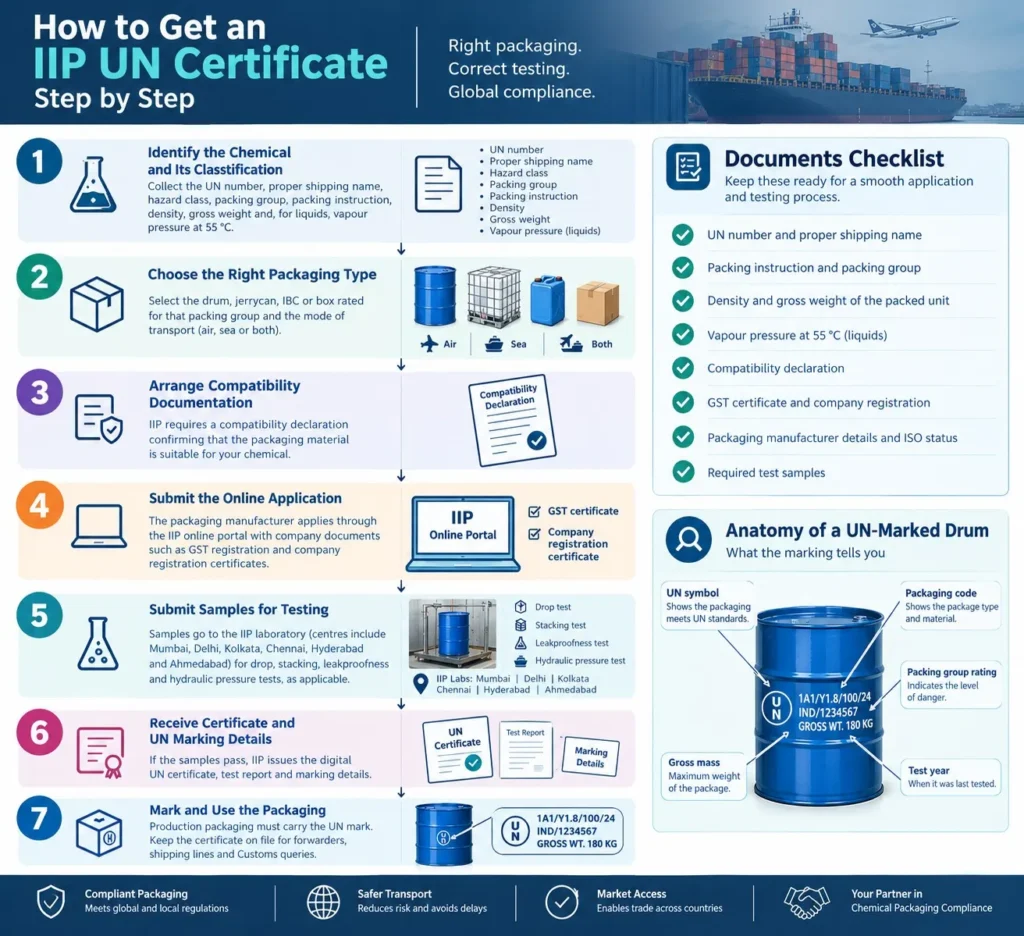
    The AL Falaah DG team manages the IIP certification process from requirement analysis to the issuance of the certificate.

    • Requirement Analysis: Our team analyzes the chemical, UN number, packing group, and transport mode for packaging testing requirements.
    • Packaging management: We collaborate with packaging manufacturers to provide samples and packaging that fulfill the requirements.
    • Application: We compile the application along with the necessary documentation.
    • Testing management: We manage the testing and certification process from sample submission until completion of the testing process.
    • Certificate issuance and management: We issue the certificate and the information on UN marking. We assist in planning for certificate renewal after its expiry.
    Frequently Asked Questions

    1. Is the IIP certification going to be voided with respect to the pre-manufactured packaging?

    No, the validity period is applicable only for the period of time when the certificate holder has the ability to manufacture packaging materials based on the certification. Note that some shipping lines still operate according to date validity; hence, you should check with your carrier prior to making your booking.

    1. Does the DGCA and DG Shipping both need it?

    Yes, depending on the transport method; DG Shipping is responsible for sea shipments according to IMDG Code while DGCA is responsible for air shipments according to IATA/ICAO regulations. Both agencies issue certificates, but a combined one can be requested.

    1. Can I ship my hazmat without a UN certificate?

    No, it isn’t safe. Your booking can be denied by the carrier, or your consignment may be detained. The UN marking of the package is the minimum requirement for transporting hazardous cargo. An expert DGR cargo handling service provider can assist you in being compliant. View our complete guide on hazardous cargo shipping in India.

    1. Is the IIP certificate accepted abroad?

    Yes, in general, since it conforms to internationally accepted UN performance standards. Hence, it is normally accepted by overseas carriers and ports as evidence of conformance.

    1. Is a certificate of a chemical transferable to another chemical?

    No, not necessarily. The certificate will be valid only for the specific UN number, packing instruction, and packing group for which testing was done.

    1. Who will take care of my IIP testing and certification needs?

    This is taken care of by AL Falaah DG.
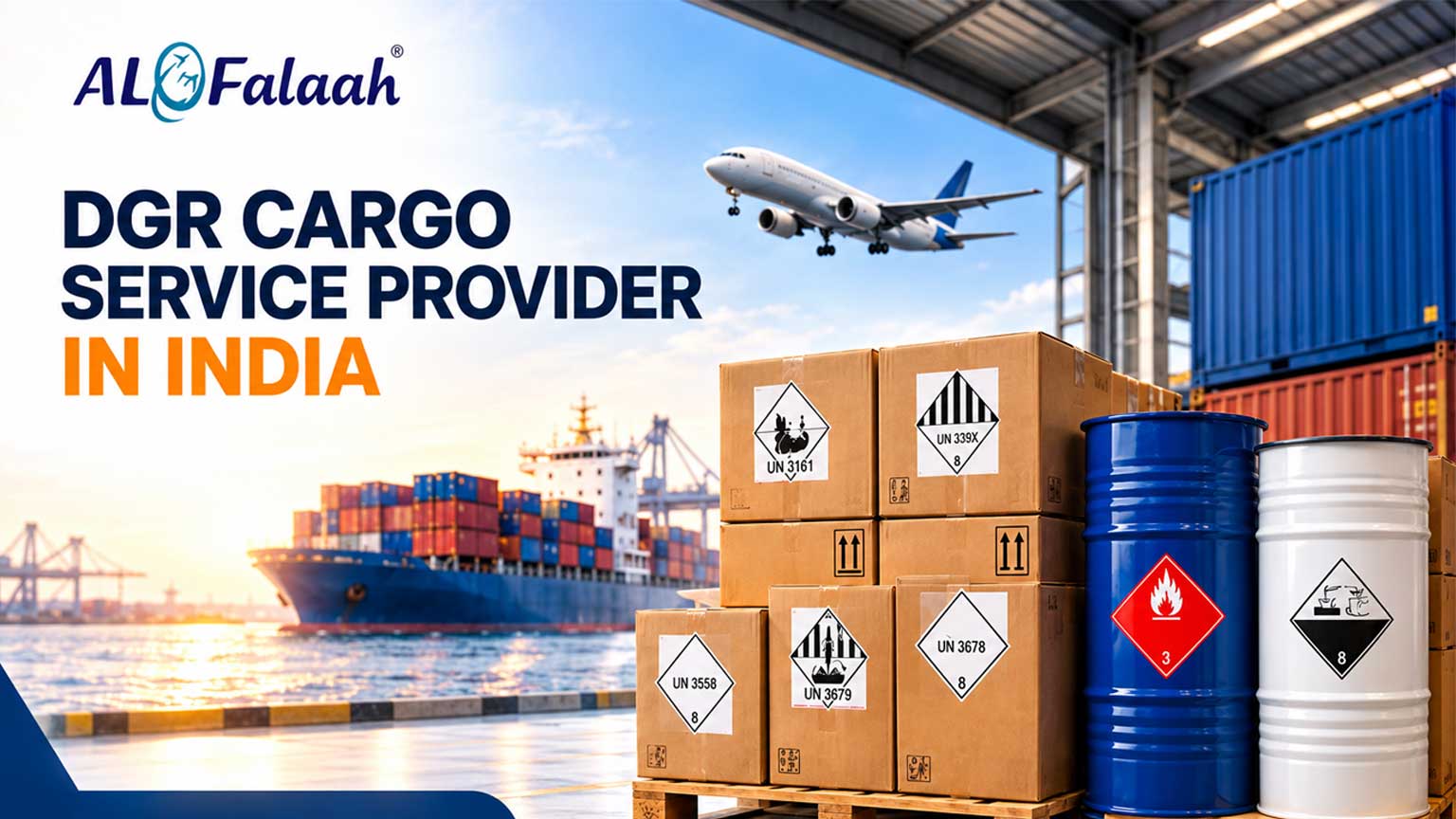
  • DGR Cargo Service Provider in India: A Complete Guide to Safe Hazardous Cargo Shipping

    DGR Cargo Service Provider in India: A Complete Guide to Safe Hazardous Cargo Shipping

    Shipping hazardous materials requires much more than arranging transportation from one location to another. Dangerous goods need to be correctly identified, classified, packed, marked, labelled and documented before they can move safely through the supply chain.

    For chemical manufacturers, pharmaceutical companies, petrochemical businesses, industrial manufacturers and freight forwarders, choosing the right DGR cargo service provider in India can make a significant difference to shipment safety, regulatory compliance and smooth delivery.

    AL Falaah DG provides dangerous goods solutions for air, sea and road freight, including dangerous goods packing, DGR packaging, UN/IIP-certified packaging support and specialised handling for hazardous cargo. With its facility in Andheri East, Mumbai, AL Falaah DG supports businesses that need practical solutions for preparing and moving dangerous goods.

    What Is DGR Cargo?

    DGR stands for Dangerous Goods Regulations. In logistics, the term is commonly used for cargo that can present a risk to people, property or the environment during transportation.

    Dangerous goods can include different types of materials, such as:

    • Chemicals and industrial substances
    • Flammable liquids and solids
    • Corrosive materials
    • Toxic substances
    • Batteries and battery-powered equipment
    • Pharmaceutical and laboratory materials
    • Radioactive materials
    • Oxidising substances
    • Other regulated hazardous materials

    The exact requirements depend on the characteristics and classification of the product and the mode of transportation.

    For air shipments, the International Civil Aviation Organization (ICAO) Technical Instructions and IATA Dangerous Goods Regulations provide the framework for identifying, classifying, packing, marking, labelling and documenting dangerous goods.

    This is why DGR logistics requires specialist knowledge rather than ordinary cargo handling.

    Why Is DGR Packaging Important?

    Packaging is one of the most important parts of dangerous goods transportation.

    A normal carton or container may not be suitable for hazardous cargo. Depending on the material and transportation requirements, the package may need to meet specific performance, construction and testing requirements.

    For example, dangerous goods packaging may need to withstand handling, stacking, pressure, impact or environmental conditions without causing leakage or damage.

    IATA specifically states that dangerous goods packaging must meet applicable requirements, and UN specification packaging is subject to defined construction and testing criteria.

    For exporters in India, UN/IIP-certified packaging is an important consideration when the shipment requires certified packaging for dangerous goods transportation by air or sea.

    The Indian Institute of Packaging (IIP) conducts testing and issues UN certification for qualifying dangerous goods packages. IIP has facilities for testing packaging according to requirements associated with air and sea transportation.

    Therefore, businesses should not select packaging simply based on size or cost. The packaging should be appropriate for the substance, quantity, packing requirements and intended mode of transport.

    DGR Cargo Services for Different Industries

    Different industries have different dangerous goods requirements. A professional DGR cargo service provider should understand these differences and help prepare shipments accordingly.

    Chemical Manufacturers

    Chemical companies regularly transport products that may be flammable, corrosive, toxic or otherwise regulated as dangerous goods.

    The right packaging and documentation help reduce the possibility of leakage, mishandling or shipment delays.

    Pharmaceutical Companies

    Pharmaceutical and laboratory shipments can involve chemicals, samples, temperature-sensitive materials, biological substances or other regulated products.

    The shipment requirements depend on the actual product classification and applicable regulations.

    Battery Manufacturers and Traders

    Batteries require particular attention during transportation, especially lithium batteries and other batteries that fall under dangerous goods regulations.

    Packaging, marking, labelling and documentation requirements should be checked before dispatch.

    Petrochemical Companies

    Petrochemical products may involve flammable liquids, gases or other hazardous substances. Their transportation requires appropriate classification, packaging and handling procedures.

    Freight Forwarders and Industrial Manufacturers

    Freight forwarders often coordinate shipments for multiple customers and product categories. Working with a specialised DGR logistics provider can help them manage the packaging and documentation requirements associated with hazardous cargo.

    Choosing a DGR Cargo Service Provider in India

    Not every logistics company offers the same level of dangerous goods expertise. Before selecting a service provider, businesses should consider several practical factors.

    1. Experience With Dangerous Goods

    Ask whether the provider regularly handles the type of dangerous goods you need to ship.

    Experience with chemicals does not automatically mean experience with batteries, radioactive materials or pharmaceutical cargo. The provider should understand the specific requirements relevant to your shipment.

    2. Packaging Capabilities

    Check whether the company provides dangerous goods packing services and whether it can arrange suitable UN specification packaging where required.

    A reliable provider should be able to explain why a particular packaging solution is appropriate instead of simply offering a standard box or container.

    3. Air and Sea Freight Knowledge

    Requirements can differ depending on whether cargo is transported by air or sea.

    For air transportation, ICAO Technical Instructions and applicable IATA requirements are important. For sea transportation, the International Maritime Dangerous Goods (IMDG) Code provides the relevant framework.

    A provider with knowledge across transportation modes can help businesses select a suitable shipping approach.

    4. Documentation Support

    Incorrect or incomplete documentation can create delays.

    The provider should understand the documentation requirements applicable to the shipment and help ensure that the required information is prepared correctly.

    5. Location and Accessibility

    For companies operating in Mumbai and nearby industrial areas, location can also be an important consideration.

    AL Falaah DG operates from J. B. Nagar, Andheri East, Mumbai, providing dangerous goods solutions from its Mumbai facility. The company states that it has been providing dangerous goods solutions since 2015 across air, sea and road freight.

    AL FalaahDG: DGR Cargo Services in Mumbai

    AL Falaah provides specialised services for businesses that need to prepare and ship hazardous cargo.

    Its services include:

    • Dangerous Goods Packing
    • DGR Packaging Services
    • UN / IIP Certificate support
    • Hazardous material packing
    • Battery packing with UN certification
    • Radioactive source forwarding
    • Air freight support
    • Sea freight support
    • Road freight solutions

    The company works with different categories of hazardous cargo and provides packaging and handling solutions based on shipment requirements.

    For businesses searching for a DGR cargo service provider in India, working with a specialised provider can simplify the process from packaging preparation through documentation and transportation coordination.

    Why Businesses Should Plan DGR Shipments Early

    Last-minute dangerous goods shipments can create avoidable problems.

    Packaging may need to be sourced or prepared. Documents may require verification. Labels and marks may need to be applied correctly. In some cases, certified packaging or testing may also be required.

    Planning the shipment early gives the shipper and logistics provider enough time to review the cargo requirements and arrange the appropriate packaging and transportation process.

    For exporters, this can be particularly important when shipments are moving internationally.

    Frequently Asked Questions About DGR Cargo

    1. What is DGR cargo service and why is it important?

    DGR cargo service covers the specialised preparation, packaging, documentation, handling and transportation of dangerous goods. It helps ensure hazardous shipments follow the requirements applicable to their classification and transport mode.

    2. What is DGR certification known for in Indian logistics?

    DGR certification generally refers to compliance, training or documentation associated with dangerous goods handling, depending on the context. For packaging, an important distinction is UN certification issued through authorised testing processes. IIP provides UN certification for qualifying dangerous goods packaging in India.

    3. How do I choose the right DGR service provider for my needs?

    Look for experience with your specific type of dangerous goods, suitable packaging capabilities, air/sea/road knowledge, documentation support and a clear understanding of applicable regulations.

    4. Which DGR cargo providers are trending in India right now?

    There is no single official ranking of “trending” DGR cargo providers in India. Instead of relying on popularity alone, businesses should compare providers based on relevant dangerous goods experience, packaging capabilities, compliance processes, service coverage and suitability for their shipment.

    5. Is UN-certified packaging required for every dangerous goods shipment?

    Not necessarily. Packaging requirements depend on the substance, classification, quantity, packing instruction and mode of transportation. The applicable regulations should be checked for each shipment.

    6. What is an IIP certificate?

    The IIP UN Certificate is an international certificate issued by the Indian Institute of Packaging (IIP) after testing dangerous goods packaging according to UN performance standards. To learn more about the IIP UN Certificate, please refer to our Comprehensive Guide to Chemical Shipment.

    7. Can dangerous goods be transported by air?

    Yes, many dangerous goods can be transported by air when they meet the applicable requirements. However, some dangerous goods are forbidden or subject to specific restrictions, quantities, packaging and documentation requirements.

    8. Can batteries be shipped as dangerous goods?

    Some batteries, including certain lithium batteries, are regulated as dangerous goods. Their classification, packaging, marking, labelling and documentation requirements depend on the battery type and shipment conditions.

    9. What industries need DGR packing services?

    Chemical, pharmaceutical, petrochemical, manufacturing, battery, laboratory and industrial businesses may require DGR packing services depending on the products they handle.

    10. Does AL Falaah DG provide dangerous goods packing services?

    Yes. AL Falaah DG provides dangerous goods packing, DGR packaging, UN/IIP certificate-related services and other hazardous cargo solutions from its Mumbai facility.

    Ship Your Dangerous Goods With the Right Preparation

    Hazardous cargo transportation starts long before the shipment reaches the airport, seaport or final destination. Correct classification, suitable packaging, accurate labelling and documentation are essential parts of the process.

    Whether you are a chemical manufacturer, pharmaceutical company, petrochemical business, industrial manufacturer or freight forwarder, choosing an experienced DGR cargo service provider in India can help you manage the specialised requirements of dangerous goods transportation.

    AL Falaah DG provides dangerous goods packing and logistics solutions from Mumbai for air, sea and road shipments.